Training "Applying AI & Technology for Enhancing Pedagogical Effectiveness"
Venue: The University of Lahore, Lahore
|
Applying AI & Technology for Enhancing Pedagogical Effectiveness Training Program | June 29-30, 2026 |
|||
|
Introduction: |
|||
|
Artificial Intelligence is rapidly transforming higher education by reshaping how educators design courses, create learning materials, assess student performance, conduct research, and manage academic responsibilities. While AI offers unprecedented opportunities to enhance teaching effectiveness and learner engagement, many faculty members seek practical guidance on integrating these technologies meaningfully and ethically into their pedagogical practices. These two day hands on workshop is designed to equip university teachers with the knowledge, skills, and tools needed to leverage AI for teaching, assessment, content creation, student engagement, and academic productivity. Through interactive activities, demonstrations, and practical exercises, participants will explore how AI can support innovative, learner centered, and evidence- based teaching practices while maintaining academic integrity and professional judgment. The workshop emphasizes practical application using leading AI tools, enabling participants to develop ready- to- use teaching resources and implementation plans for their own courses. |
|||
|
Training Objectives: |
|||
|
The workshop aims to:
|
|||
|
Learning Outcomes: |
|||
|
By the end of the workshop, participants will be able to:
|
|||
|
Target Audience: |
|||
|
|||
|
Trainers: |
|||
|
Prof. Dr. Rehana Kouser Dr. Saima Aftab |
|||
|
Registration Fee: |
|||
|
35,000/- PKR (per person) |
|||
|
Notes: |
|||
** If unforeseen circumstances occurs during the workshop and one day before the scheduled workshop, NBEAC will not refund the registration fee. |
|||
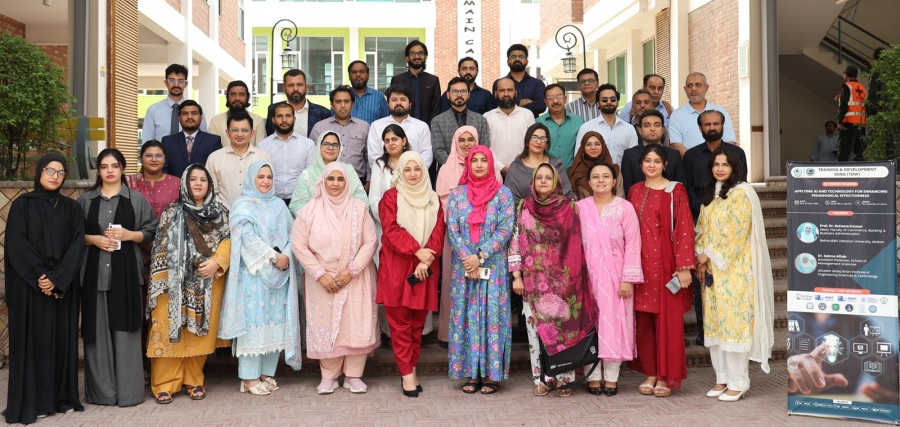
The National Business Education Accreditation Council, in collaboration with The University of Lahore, successfully organized a two-day national training workshop titled "Applying AI & Technology for Enhancing Pedagogical Effectiveness." The University of Lahore hosted the training, which brought together around 21 faculty members from universities across Pakistan, representing a diverse range of higher education institutions and academic disciplines.
The training was facilitated by Prof. Dr. Rehana Kouser from Bahauddin Zakariya University, Multan, and Dr. Saima Aftab from Ghulam Ishaq Khan Institute, Swabi, both recognized experts in technology-enabled teaching and learning.
The workshop aimed to equip participants with practical knowledge and hands-on experience in integrating AI into higher education teaching and learning. Through interactive sessions, demonstrations, and practical exercises, participants explored the effective use of AI for course design, lesson planning, assessment development, content creation, student engagement, and academic productivity.
The training also focused on promoting the responsible and ethical use of AI in academic settings while enabling faculty members to develop innovative, learner-centered, and evidence-based teaching practices. Participants gained practical exposure to AI-powered tools for designing teaching materials, developing authentic assessments, creating interactive learning experiences, and improving instructional effectiveness.
The workshop witnessed enthusiastic participation from around 21 faculty members representing universities across Pakistan, fostering collaboration, knowledge sharing, and the exchange of best practices in AI-assisted pedagogy. The interactive nature of the sessions provided participants with an opportunity to develop actionable implementation plans for incorporating AI into their respective courses and academic environments.
NBEAC extends its appreciation to The University of Lahore for hosting the training workshop and facilitating this important national capacity-building initiative.
Powered by iCagenda
| Mon | Tue | Wed | Thu | Fri | Sat | Sun |
|---|---|---|---|---|---|---|
|
1
|
2
|
3
|
4
|
5
| ||
|
6
|
7
|
8
|
12
| |||
|
13
|
14
|
15
|
16
|
17
|
18
|
19
|
|
20
|
21
|
22
|
23
|
24
|
25
|
26
|
|
27
|
28
|
29
|
30
|
31
| ||

About NBEAC
NBEAC has three main functions: accreditation, training and networking. In its accreditation function, it develops and implements standards to improve the quality of business education in Pakistan. In its training function, it provides opportunities to faculty and managers to learn about quality standards and related matters. In its networking function, it provides a forum for business education professionals to learn from each other through conferences and seminars.