Workshops
Training "Driving Societal Impact through Business Education"
|
Driving Societal Impact through Business Education Online Training Program | October 28, 2026 |
|||
|
Introduction: |
|||
|
Business schools play a critical role in shaping responsible leaders and advancing social and economic development. This training explores how institutions can embed societal impact across their curriculum, research, student engagement, industry partnerships, community initiatives, and institutional strategy. Participants will gain practical frameworks and insights to identify impact opportunities, design meaningful initiatives, engage stakeholders, and measure outcomes, enabling them to create lasting and sustainable societal impact. |
|||
|
Training Objectives: |
|||
|
By the end of the training, participants will be able to:
|
|||
|
Target Audience: |
|||
|
Deans, Directors and Heads of Business Schools , Senior Faculty and Academic Leaders , Program/Department Coordinators , Quality Assurance & Accreditation Professionals , Researchers and Academic Administrators , Faculty involved in curriculum development, research and community engagement , Office of Research, Innovation and Commercialization (ORIC) , Industry Representatives |
|||
|
Trainers: |
|||
|
|||
|
Registration Fee: |
|||
|
15,000/- PKR (per person) |
|||
|
Notes: |
|||
** If unforeseen circumstances occurs during the workshop and one day before the scheduled workshop, NBEAC will not refund the registration fee. |
|||
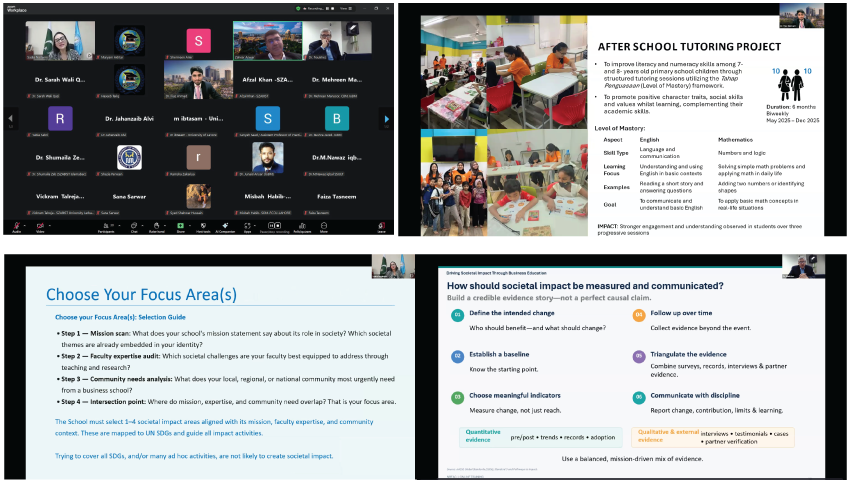
The Training and Development Wing (TDW) of the National Business Education Accreditation Council (NBEAC), Higher Education Commission (HEC), organized an online training program titled “Driving Societal Impact through Business Education” on October 28, 2026
The training was led by Dr. Naukhez Sarwar, Principal and Dean, NUST Business School, and Dr. Sadia Nadeem, Dean and Professor, FAST Business School. The international guest speakers included Dr. Geoff Perry, Executive Vice President and Chief Officer, AACSB; Mary Sully De Luque, Professor of Global Management, Thunderbird School of Global Management, Arizona State University, Dr. Zaheer Anwer, Professor and Deputy Dean (Internationalization), Sunway Business School, Sunway University, Malaysia; and Dr. Fiaz Ahmad, Head – Advisory and Research Advocacy, Asian Strategy and Leadership Institute, Sunway Education Group;
The training focused on the role of business schools in creating meaningful societal impact through curriculum, research, student engagement, industry partnerships, community initiatives, and institutional strategy. The sessions provided participants with practical insights and frameworks to identify impact opportunities, engage stakeholders, design meaningful initiatives, and measure outcomes.
The speakers also highlighted the importance of distinguishing between activities, outputs, outcomes, and impact to effectively assess and demonstrate the contribution of business schools to social and economic development.
The interactive training brought together Deans, Directors and Heads of Business Schools, senior faculty and academic leaders, program coordinators, quality assurance and accreditation professionals, researchers, academic administrators, and representatives involved in curriculum development, research, community engagement, and industry collaboration from across Pakistan.
The initiative is part of NBEAC’s continued efforts to enhance the capacity of business schools and promote quality, relevance, responsible leadership, and meaningful societal impact through business education in Pakistan.
Powered by iCagenda
About NBEAC
NBEAC has three main functions: accreditation, training and networking. In its accreditation function, it develops and implements standards to improve the quality of business education in Pakistan. In its training function, it provides opportunities to faculty and managers to learn about quality standards and related matters. In its networking function, it provides a forum for business education professionals to learn from each other through conferences and seminars.